Freelance Web Designer Rates in 2026: Pricing, Day Rates and Website Budgets

There is no single rate for a freelance web designer. Two projects that look similar on paper can have very different budgets depending on their structure, UX complexity, level of customization, CMS requirements, animations, development scope and, importantly, how the website will be managed and evolve after launch. A site that will remain relatively stable does not need the same architecture as one a marketing team needs to manage and expand independently.
For a useful market reference, Malt’s 2026 benchmark puts the average day rate for an experienced freelance web designer in France at €423. That is a helpful benchmark, but not a formula for pricing a website. A Figma design package, a small set of pages built for a one-off need and a complete system designed so a client can create new pages or content without a developer involve very different amounts of work.
What is the average freelance web designer rate in 2026?
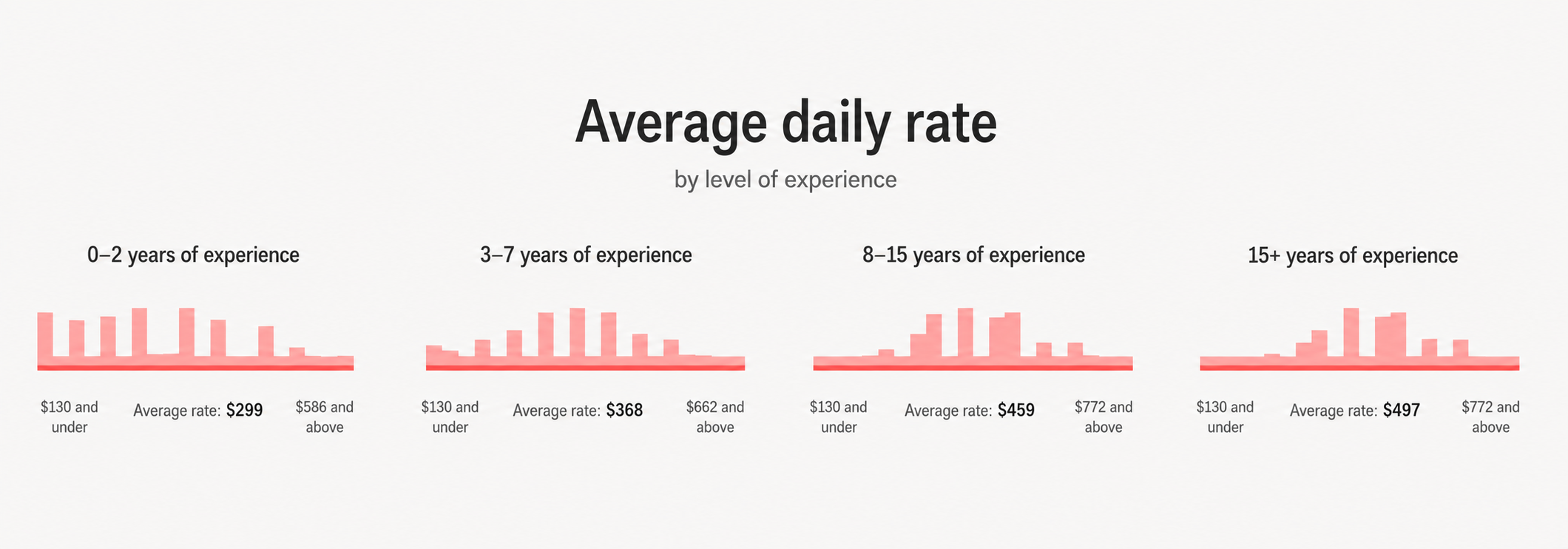
A day rate is one of the simplest ways to benchmark freelance pricing. In France it is often referred to as the TJM, or tarif journalier moyen. The Malt 2026 rate benchmark reports the following averages for web designers active on its platform:
- 0 to 2 years of experience: €276/day
- 3 to 7 years: €340/day
- 8 to 15 years: €423/day
- More than 15 years: €458/day
I would therefore use €423 per day as a benchmark for an experienced freelance web designer in the French market, with one important caveat: it is an average observed on Malt, not an official rate and not a project price.
Day rate, hourly rate or fixed fee: how does a web designer charge?
The right pricing model depends on the assignment. A day rate works well for agency collaborations, longer engagements or projects where the scope may evolve. Hourly pricing is usually better suited to small, one-off tasks.
For a complete website or redesign, I generally prefer a fixed project fee based on a precise scope. In my proposals, that fee corresponds to defined deliverables, responsibilities and level of polish rather than an arbitrary number of days.
I still use a day-rate logic internally when estimating the workload. For the client, a project fee simply makes the scope and budget easier to read.
How much does website design cost without development?
It is important to separate UX/UI design from a complete website build. A design-only project may include information architecture, wireframes, high-fidelity Figma designs, components, responsive layouts and, where useful, a prototype, without including development.
I do not use a standard price range for this type of work. The quote depends on the number of pages to design, the number of genuinely different page types, user-journey complexity, art direction, the design system, responsive work and revision rounds.
It also matters what the client needs to do afterwards. If a marketing team needs to create new case studies, offers, campaign pages or other content without going back to the designer every time, the design phase should already anticipate reusable page structures, consistent components and a content model that is simple enough to manage independently. Designing for that level of autonomy requires more thought upfront than designing only the pages needed for launch.
How much does a complete website with design and development cost?
Again, there is no standard price for a business website or a complete custom website. Page count is one of the first pricing criteria, but it needs to be considered alongside CMS architecture, features, level of customization, content, animations, responsive work, SEO, integrations and the level of autonomy required after launch.
The question is therefore not only “how many pages do we need today?”, but also who will manage the website tomorrow and what should they be able to create without technical help? If a team needs to publish new projects, add services, build campaign pages or expand certain sections, the CMS has to be designed accordingly: collections, fields, relationships, reusable components, conditional sections and editing rules that make sense to the people using the site every day.
This is why I price each project individually. A launch-focused website and one intended to become a real working tool for the client or marketing team can look similar in visible scope while requiring very different systems and amounts of work behind the scenes.
On a complete project, my work can run from discovery and UX through to Webflow development, CMS architecture, SEO foundations, testing and launch.
Why can two web designers quote very different prices?
Two quotes can list the same number of pages while involving very different levels of work and process. In a simpler approach, the work may start from an existing structure, apply the brand identity, integrate the content and handle the necessary responsive adjustments. That can be exactly right for the brief, but it involves a lower level of customization and project-specific design.
A genuinely custom project can instead include discovery, positioning, information architecture, page planning or wireframes, multiple creative directions, bespoke UI design, responsive behavior, components, CMS architecture, development, interactions, technical SEO foundations, QA and launch. Each of those stages adds time, but it also increases how precisely the website responds to the brand, its users and its business goals.
Both quotes could still contain the same line: “10-page website”. To compare them properly, look at the process being proposed, what is included at each stage, the level of custom work and the autonomy the website will provide after launch.

What actually changes the price?
- The level of custom work and the process: adapting an existing base is not the same workload as shaping the UX, visual direction and site system around the specific goals of the project.
- Pages and page types: ten highly different layouts require more design work than a site built around a smaller set of coherent, reusable structures.
- UX complexity: a landing page, SaaS product, catalogue or member area involves different journeys and interface states.
- Art direction: designing within an existing identity is different from defining a new visual direction.
- Responsive work: layouts and interactions need to work across mobile, tablet and different desktop widths.
- Client autonomy and ongoing management: a site that is rarely changed does not need the same architecture as one where a marketing team needs to create new content, projects, offers or pages regularly without a developer.
- CMS and functionality: collections, content relationships, fields, filters, advanced forms, member areas, multilingual content, ecommerce and integrations increase design and development time.
- Content and SEO: copy, imagery, metadata, internal linking and structured data may be included in the scope or supplied separately.
- Timeline and revisions: urgent delivery and extensive revision cycles also affect the workload.
Web design, branding, content and SEO: check what is included
A common source of price differences is the work around the website itself. Brand identity, copywriting, photography, illustration, custom animation or SEO strategy may be included, quoted separately or handled by another specialist.
For SEO, I separate the foundations built into the site, heading structure, performance, responsive behavior, metadata, internal linking and structured data, from ongoing SEO work such as content production, link acquisition and ranking monitoring. These foundations can be addressed as part of my web design and development services.
Before comparing two totals, check who is responsible for each part of the project.

Why a freelancer’s day rate is not their salary
A €400 or €500 day rate does not mean €400 or €500 of personal income per day. Freelance revenue has to cover taxes and social contributions, insurance, software, equipment, training and other business costs.
A significant part of the working week is not billable either: prospecting, preparing proposals, accounting, administration, communication, training and time between projects.
The day rate therefore has to support both the billable project days and the work required to make those project days possible.
Does a more experienced web designer always cost more overall?
Not necessarily. A higher day rate can be offset by faster scoping, fewer unnecessary revisions, stronger decisions early in the process and fewer technical corrections during development.
The day rate should therefore not be judged in isolation. I would look more closely at the quality of the process, the level of advice, the deliverables and the designer’s ability to take the project through to the required result.
In my case, combining UX/UI design and Webflow development means I can think about how each interface will actually be built, animated and adapted to mobile from the Figma stage. It also means the components and CMS structures the client will need later can be planned much earlier in the process.

Freelancer or agency: which costs less?
For a comparable scope, an agency will generally quote a higher budget because it supports a larger structure and distributes the project across several roles, such as a project manager, designer, developer, SEO specialist or art director.
The difference is not as simple as “an agency has several experts while a freelancer has one skill”. An experienced freelancer can develop a much broader set of complementary skills through years of working across different projects, industries and constraints. That can mean connecting strategy, UX/UI, design systems, CMS architecture, Webflow development, technical SEO, integrations and QA within one overall view of the project.
That is how I work. Experience across very different types of websites and project situations allows me to make decisions more holistically. A choice made in Figma can already take into account the Webflow build, responsive behavior, CMS structure, client autonomy, SEO and how the website may evolve later. This reduces handoffs and gives the client one main point of contact who understands the project as a whole.
An agency remains a strong option when the project needs several highly specialized experts working in parallel, greater production capacity or more complex team governance. The right choice therefore depends on the project complexity, the depth of specialization required and how those skills need to be organized.
A website built for launch or built to evolve: why does the price difference matter?
A website can be built mainly around today’s requirements, with pages that will change very little after launch. That is a simpler setup and can be perfectly appropriate when the content rarely evolves.
Other businesses need their teams to create new pages, publish projects, launch campaigns or update content without depending on a designer or developer. In that case, the job is no longer just to design the pages visible at launch. It means building an editorial system with a well-structured CMS, reusable page models, components and editing rules that are clear to the people who will actually manage the site.
That architecture requires more work upfront, but it gives the client genuine autonomy and prevents every future update from becoming a new technical task. Pricing therefore also depends on how the website will need to be managed and evolve after delivery.
How should you compare two web design quotes?
Before looking at the total, check:
- the project stages and deliverables;
- the level of custom work and what is actually being designed specifically for the project;
- the number of pages and genuinely different page structures;
- the responsive work included;
- features, CMS requirements and integrations;
- what the client or marketing team will be able to edit and create independently after launch;
- the number of creative directions and revision rounds;
- who provides the copy, imagery and other content;
- whether development, technical SEO and testing are included;
- licenses, third-party costs and out-of-scope requests.
These details often explain immediately why two quotes that differ by several thousand euros do not cover the same service.
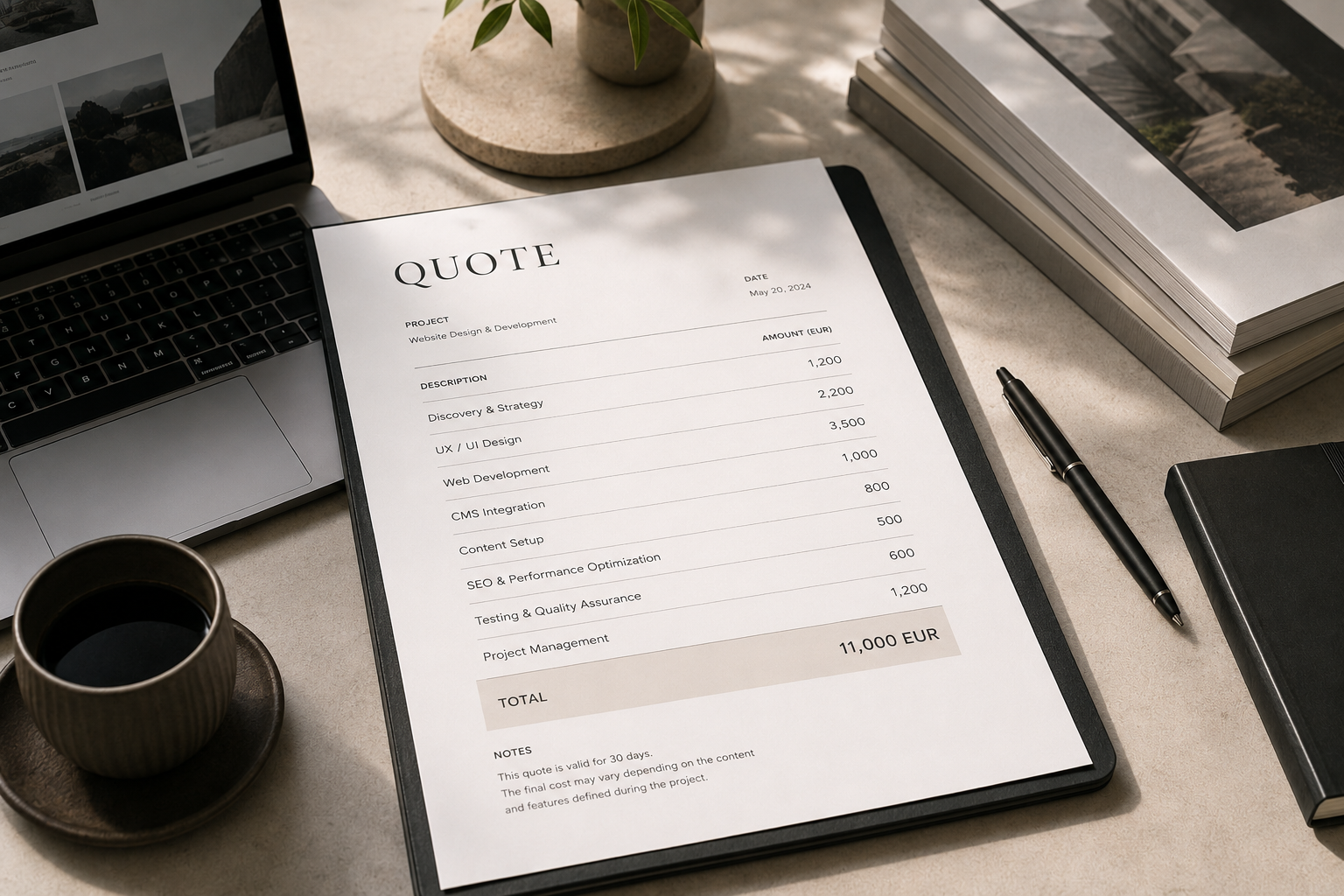
How I price a web project
After more than six years designing and developing websites, I do not price a project from page count alone. I start with the business, the goals of the website, its users and the information architecture required.
I then look at the page types, CMS, functionality, level of art direction, content, animations and technical constraints. I also want to understand who will manage the website after launch, how often it will evolve and which new content or pages the team needs to create internally. That is what allows the CMS and component system to be scoped properly instead of building only the pages visible on launch day.
During the design phase, I present two creative directions, then develop the chosen route until the interface is genuinely aligned with the project. Once the design is approved, I can continue through Webflow development, optimization and launch. The advantage is continuity from the initial thinking through to the finished website and its day-to-day use.
You can see projects with very different requirements and visual directions in my freelance web designer portfolio.
What budget should you plan for your website?
A useful estimate starts with a clear scope. A company that already has its brand identity, copy and a defined site structure is not starting from the same place as a brand that needs to build everything from scratch.
Page count is part of the calculation, but it needs to be considered alongside CMS architecture, features, animations, responsive work, content, level of customization and the degree of autonomy required after launch. The expected publishing rhythm and the team’s ability to expand the site internally therefore shape the system that needs to be built, beyond what is visible on launch day.
Market averages are useful for context, but they cannot price an individual project. For the project itself, only a defined scope produces a reliable quote. If you want an initial estimate, you can use my online website pricing estimator, then refine the scope with me if needed.
Sources and methodology
The figures in this article are market benchmarks for France and were checked in August 2026. The main day-rate reference is the Malt 2026 rate benchmark.
Those sources do not always describe the same services. That is precisely why I do not present a standard price for a UX/UI design package or a business website: the price depends on the actual scope, but also on the level of autonomy and scalability required after launch.
FAQ
What is the average freelance web designer day rate?
According to Malt's 2026 benchmark, the average day rate for an experienced freelance web designer active on the platform is €423 per day. Rates then vary according to experience, specialization and the type of project.
How much does a beginner freelance web designer charge?
Malt reports an average of €276 per day for profiles with zero to two years of experience. This is a platform benchmark, not a minimum or mandatory rate.
How much does a Figma website design cost?
There is no standard price. The budget depends on the number of pages or unique templates to design, UX complexity, responsive work, level of customization, design system, possible prototypes and revision rounds. I therefore price this type of work case by case.
How much does a business website cost with a freelance web designer?
The price is assessed case by case. It depends on page count, CMS architecture, features, customization, content, animations, responsive work, SEO and, crucially, how the website needs to be managed after launch. A site that changes rarely does not require the same system as one where a marketing team needs to create new pages or content independently.
Does a web designer also develop the website?
Not always. Some web designers deliver the designs and work with a separate developer. Others handle both. On my projects, I can take care of the Figma design and then the Webflow development through to launch.