Webflow AEO and SEO: Get Found in ChatGPT and AI Search
A potential client asks ChatGPT which specialist to hire. Your competitor appears, but you do not. Before deciding that your Webflow site needs another file or an AEO hack, ask a more useful question: do your pages clearly explain what you do, who you help and what evidence supports your expertise?
The goal is not simply to have an article cited. For a business or independent specialist, it is also to be considered when a prospective client compares solutions. Here is how to approach that work on Webflow, without confusing visibility, recommendations and guaranteed results.
Editorial update: October 7, 2026.
How do I make my Webflow content appear in ChatGPT, Perplexity and Google AI Overviews?
Start with pages that search systems can access, then answer your prospective clients' questions with specific, verifiable information. Explain your expertise, services and limitations, connect relevant content and develop credible external references. Track brand mentions, cited links and enquiries separately. No file or markup can guarantee that an AI assistant will recommend your business.
To put this into practice, start with one important service page and one specific buying question. That gives you a more useful audit scope than a vague ambition to appear everywhere in AI search.
1. Understand the difference between SEO, AEO and GEO
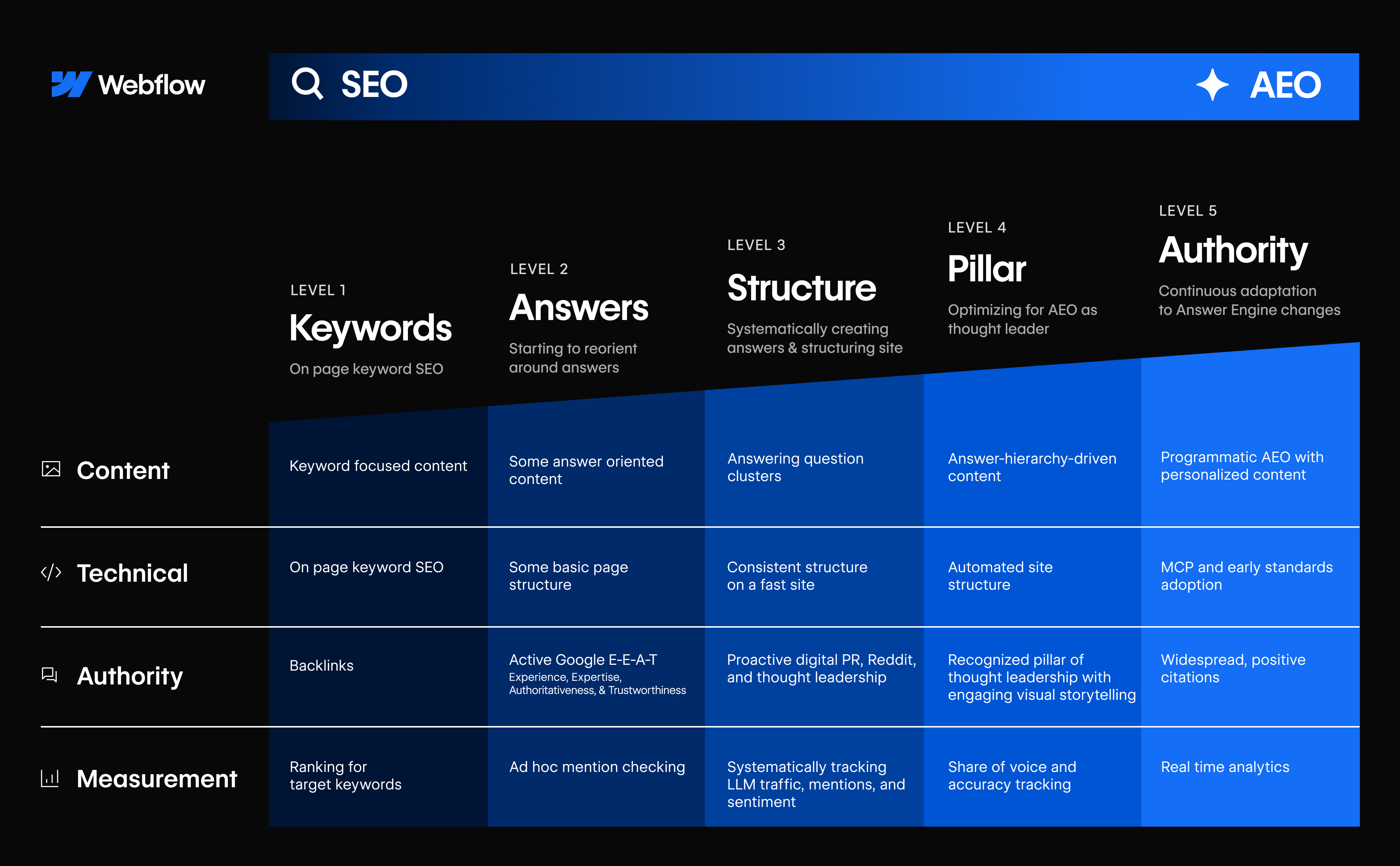
SEO focuses on search engine visibility. AEO, Answer Engine Optimization, focuses on direct answers. GEO, Generative Engine Optimization, concerns experiences that generate a response using different pieces of information. These terms overlap: they are not three independent technical recipes.
For Google, SEO fundamentals still apply to AI Overviews and AI Mode. Its generative search guidance does not require content rewritten exclusively for AI or special markup.
Being mentioned, recommended or cited: three different goals
For measurement, distinguish a mention, where your name appears, a recommendation, where your business is suggested for a particular need, and a citation, where a page is credited as a source with a link. A cited tutorial does not automatically mean your services are being recommended.
A web search performed by an assistant is also different from an answer drawn from the model's existing knowledge. In your diagnostic work, record whether search was used and which sources actually appeared, rather than relying on a single response.
2. Make the site crawlable and indexable
On Webflow, I start by checking how the priority pages work before adding more content. The aim is to remove observable obstacles, not to assume that every missing citation has a technical cause.
- Access: the public page returns a 200 status, without a password or protection that prevents it from being viewed.
- Indexing: there is no accidental noindex directive, and the canonical points to the appropriate URL rather than an old page or another language.
- Discovery: the relevant URL is in the sitemap and can be reached through internal links.
- Content: important information is available as text, not exclusively in an image, video or module loaded after interaction.
- Crawlers and security: robots.txt and any firewall do not block the search crawlers you intend to allow.
Which crawlers should you allow for ChatGPT and Perplexity?
OAI-SearchBot is for ChatGPT search; GPTBot relates to potential use of content for training. OpenAI lets you manage them independently: allowing search does not require allowing training. ChatGPT-User handles certain user-initiated visits rather than automatic Search indexing. See the official OpenAI crawler definitions.
PerplexityBot supports Perplexity search. When investigating a firewall block, check the official IP ranges rather than trusting the crawler name alone. The Perplexity documentation also distinguishes this crawler from on-demand visits.
The Google setting to check in 2026
Googlebot remains the crawler for Google Search. Also check the Search generative AI control in Search Console: an exclusion can prevent your content and links from appearing in the relevant features. This setting is separate from Google-Extended, which does not replace the Search visibility control.
3. Structure headings and HTML logically
Use a main H1 for the topic, H2 headings for major sections and H3 headings for subsections. In the Designer, choose tags for their purpose and classes for their appearance. Elements such as main, article, nav and footer support a comprehensible structure, including for accessibility.
For a specific question, I recommend a direct answer followed by conditions, steps or evidence. This helps readers find the information they need; it is not a paragraph-length rule imposed by AI systems.
Example: turn a vague promise into a useful answer
Overly general copy: “We deliver high-performance, SEO-optimized Webflow migrations.”
The question to answer: “How should you prepare a Webflow migration to reduce SEO risks?”
Before migrating to Webflow, inventory your existing URLs and identify the pages receiving traffic or backlinks. Keep relevant addresses where possible; map changed URLs to their replacements. Then check redirects, canonicals, internal links and indexing after launch. This preparation reduces avoidable mistakes, but it cannot guarantee unchanged traffic.
This is a writing example, not a client result. It specifies the problem, the actions and the limitation. You can then add your own checklist or a documented case study. There is no need to repeat the answer in five FAQs or artificially split every idea into tiny paragraphs.
4. Use structured data without overestimating it
Structured data explicitly describes certain elements of a page. Depending on the content, Article or BlogPosting, BreadcrumbList, Person, Organization, LocalBusiness or Service may be relevant. These types do not all qualify for the same rich results, and none guarantees an AI citation.
For a Webflow article, check the headline, author, images and dates. The publication date should not be reset to today whenever you edit the page. A modification date should reflect a genuine update. Google's Article documentation explains the supported properties.
In a CMS template, inspect the output on several articles and in each language. Avoid conflicting markup blocks, invented reviews or structured data describing information that is absent from the page.
.webp)
Webflow's SEO and AEO tools make this work easier. They do not replace checking the generated content or choosing appropriate markup for each page.
5. Optimize the meta title and meta description
Choose a title that combines the topic with a clear benefit rather than a string of keywords. For this article, “Webflow AEO: Get Cited by ChatGPT & Perplexity” describes the scope without promising a number-one position.
The description should then explain what readers will learn: crawler access, useful answers, evidence and measurement. Avoid generic wording such as “Discover our complete and innovative guide” when describing the actual content would be more informative.
On a multilingual site, adapt these fields to the reader's language. A natural English title is not necessarily a word-for-word translation of the French version.
6. llms.txt: worth testing, not a priority
Not having llms.txt does not, by itself, explain why you are missing from AI answers. This experimental format can be tested with tools that support it, but it does not replace an XML sitemap, accessible pages or useful content.
Google states that it ignores these files for Search, including generative features: they neither help nor hurt rankings. Its official guide also rejects the idea of special AI schema. Treat llms.txt as a documented experiment, not the central deliverable of an audit.
7. Publish original content that is hard to replicate
Before looking for new topics, review your quote requests and discovery-call notes. Which questions come up before a decision? Which constraints prevent a prospect from choosing? I recommend building content around those situations rather than publishing interchangeable articles about the benefits of Webflow.
Three types of questions to cover
- Understanding: “What needs to be planned before a website redesign?” An educational resource can clarify the steps and responsibilities.
- Comparing: “Is Webflow suitable for a multilingual website managed by a marketing team?” Explain the criteria, limitations and requirements for team autonomy.
- Choosing a provider: “Which freelancer can take over an existing Webflow site and train our team?” Your service page should explain the scope, deliverables and relevant projects.
These are working examples, not search-volume data. Several questions can belong on one page when they address the same need. Avoid creating a nearly identical URL for every variation in wording.
What evidence should you add to a service page or article?
Replace “recognized expertise” with something verifiable: an explained project, an annotated screenshot, part of your process, a deliverable or an approved client testimonial. A useful case study describes the starting situation, your contribution and what was actually observed.
For a numerical result, provide the timeframe, source and limitations. Without reliable measurement, describe the work completed rather than inventing a percentage. This approach aligns with Google's guidance on helpful content and first-hand experience.
What I implement on Webflow sites
My work connects technical auditing, page architecture, CMS structure and content clarity: crawling, indexing, canonicals, redirects, titles, structured data, internal links and performance. The goal is to turn general recommendations into verifiable improvements on your priority pages.
This approach is part of my Webflow development and optimization services, without making the entire project depend on an abstract AEO score.
8. Improve performance and internal linking
Build a useful journey: an article explains a problem, a service page describes the support available, a case study provides evidence and a contact page makes the next step possible. Choose descriptive, relevant links rather than repeating identical anchor text everywhere.
For performance, check image dimensions and file sizes, lazy loading below the fold, necessary JavaScript and visual stability. Use PageSpeed Insights to identify problems, without presenting a good score as a guarantee of AI recommendations.
Do not overlook your French and English versions
Check that each published version has an accessible URL, an appropriate canonical and reciprocal hreflang links to its equivalents. Google explains these annotations in its multilingual documentation. Within the content, direct readers to services, evidence and contact information in their own language wherever possible.
9. Build authority and measure what works
Make your expertise verifiable beyond your website
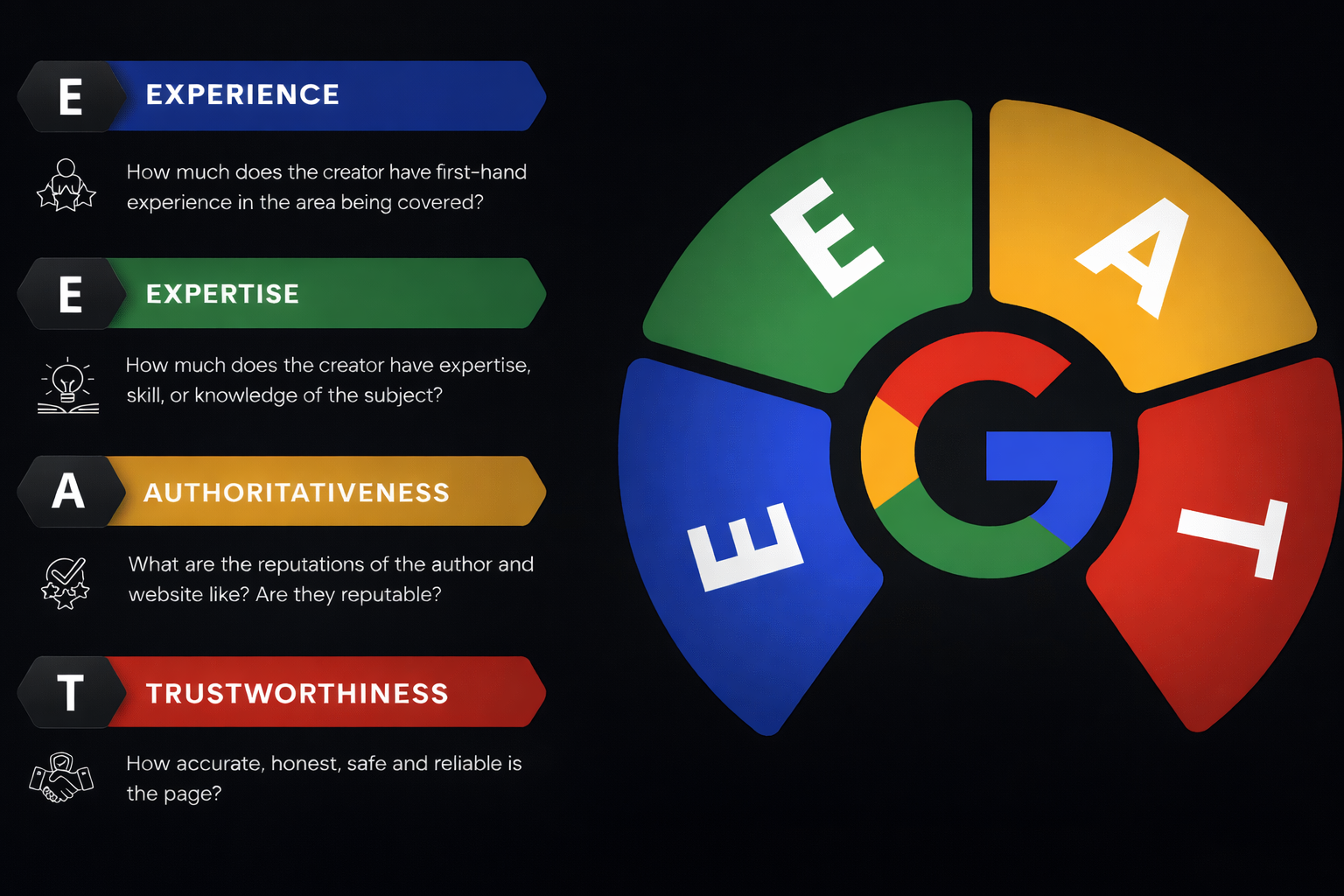
I recommend aligning your author page, professional profiles and partner introductions: a consistent name, a clear activity and coherent specialisms. A documented client reference, a specialist contribution or a relevant editorial mention gives readers more to evaluate than a self-declared leadership claim.
Do not turn this work into buying fake reviews or planting artificial forum posts. The aim is for other sources to be able to confirm your experience. E-E-A-T is a quality framework, not a universal score that every assistant assigns to your business.
Build a repeatable visibility check
For an initial diagnostic, I suggest a sample of 12 to 20 questions drawn from your business. Separate questions containing your brand name from those that do not. Test French and English versions in fresh conversations, recording the platform, date, language and whether web search was used.
For each answer, save the recommended businesses, the URLs actually cited and any inaccurate information. Repeat the same protocol at regular intervals. A visibility percentage describes only that sample: it is not a global market share or a stable position across all AI answers.
Connect citations to traffic and enquiries
In Search Console, the Search Generative AI report tracks impressions, pages and countries, plus devices for Search. Google states that the worldwide rollout was completed on August 31, 2026. The data remains included in overall performance; it does not measure ChatGPT or Perplexity citations.
For ChatGPT, OpenAI says it adds utm_source=chatgpt.com to referral links, helping identify visits in analytics. See its official publisher FAQ. Review landing pages, contact requests and lead quality as well. Measurable referral traffic does not capture mentions that generate no click.
10. Where should you start on your Webflow site?
Priority 1: remove obstacles. Check access, indexing, crawlers and the URLs of your important pages. Document the errors you actually find.
Priority 2: clarify three strategic pages. Choose a service page, a case study and an article answering a buying question. Make their answers, evidence and next steps explicit.
Priority 3: connect and substantiate. Add useful internal links, check authorship and references, then fix inconsistencies between languages.
Priority 4: measure before expanding. Record a baseline, your changes and their dates. Compare subsequent observations, traffic and enquiries. Do not automatically attribute every variation to the latest edit.
This plan sets an order of work, not a guaranteed deadline for appearing in ChatGPT. A fix can be quick to publish; discovery and source selection remain outside your publishing schedule.
Conclusion
Good AEO work on Webflow makes your expertise easier to find, understand and verify. It does not replace SEO or depend on a magic file. The best starting point is a precise answer to a real client question, supported by an accessible page and credible evidence.
Need to identify which pages and obstacles to tackle first? A review of your Webflow structure, technical SEO and content can establish practical priorities, without promising a recommendation that nobody can guarantee.
FAQ
What is the difference between being cited and recommended by ChatGPT?
A citation links to a page used as a source. A recommendation suggests your business for a particular need. An article can be cited without your services being recommended, so track source links, brand mentions and business enquiries separately.
Do you need llms.txt to appear in AI answers?
It is not a universal requirement. Google states that it ignores llms.txt for Search, including generative features. For other systems, check documented support. Start with accessible pages, useful answers and evidence rather than this experimental file.
Can you block GPTBot while remaining visible in ChatGPT Search?
Yes. OpenAI distinguishes GPTBot, which relates to training, from OAI-SearchBot, which is used for search. Their permissions are independent. Also check that server protection does not block OAI-SearchBot. Allowing access does not guarantee a citation.
How long does it take to be cited after AEO improvements?
There is no guaranteed timeframe. Publishing a fix does not mean search systems have discovered it or will select it as a source. Compare repeated observations using a consistent protocol and track enquiries, rather than drawing conclusions from one answer.
How do you measure a Webflow site's visibility in AI search?
Combine a recurring sample of business questions with actual cited URLs, referral visits and conversions. For Google, use Search Console's Search Generative AI report. Keep platforms and languages separate, and do not present your sample's visibility rate as a global market share.